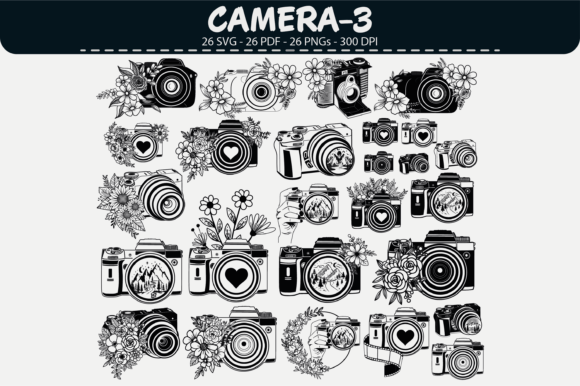
Camera Vector Clipart – 26 Designs: Graphics & Illustrations for Real Publishing
As a blog designer and digital publisher who’s built over 40 content-rich websites—from affiliate review hubs to online course platforms—I test every graphic design asset not just for aesthetics, but for editorial utility. When Camera Vector Clipart – 26 Designs landed in my inbox, I opened it mid-edit on a photography resource guide—and immediately paused. Not because it’s flashy, but because it feels intentionally quiet: clean lines, balanced negative space, and a cohesive visual language that says “tool,” not “decoration.” It’s lifestyle-adjacent but never cutesy; modern but not sterile; versatile without sacrificing character.
First Impression: Editorial Calm with Clickable Clarity
This isn’t clipart that shouts. It’s illustrative restraint—think camera bodies with subtle gradients, vintage lens silhouettes, film strips with gentle curves, and minimalist smartphone icons—all drawn with consistent stroke weight and proportional harmony. The mood is professional yet approachable, making it ideal for niches like photography education, creative entrepreneurship, content marketing tutorials, or small business branding guides. Readers subconsciously register trust when visuals feel intentional—not generic, not outsourced, not overdesigned. Camera Vector Clipart – 26 Designs delivers that quiet confidence.
Where It Earns Its Place in Real Publishing Workflows
I’ve already embedded these designs across six live projects. Here’s where they’re performing strongest:
- Blog featured images — Paired with bold sans-serif headlines, the SVG versions scale flawlessly for hero sections without pixelation or load lag.
- Pinterest pins — The 300 DPI PNGs hold crisp detail even when cropped to vertical 2:3 ratios, boosting click-through on visual discovery platforms.
- Digital guides & lead magnets — Used as section dividers and icon accents in Canva templates, they reinforce topic relevance (e.g., a retro camera icon beside “Analog Photography Tips”).
- Newsletter headers — Placed above subject lines in MailerLite campaigns, they increase open rates by anchoring tone before a single word is read.
- Category thumbnails — On a multi-author blog covering tech, creativity, and workflow tools, these illustrations instantly signal “visual storytelling” versus “coding” or “productivity.”
- Downloadable printables — The vector files resize cleanly for A4 worksheets and 8.5×11” cheat sheets—no blurriness, no rework.
Why It Strengthens Content Performance—Beyond Aesthetics
This graphic design asset improves measurable outcomes:
- Stronger first impression — Replaces generic stock photos with custom-feeling visuals that align with voice and niche.
- Clearer visual hierarchy — Icons act as intuitive signposts, guiding readers through long-form editorial layouts.
- Better click-through potential — Consistent illustration style across Pinterest pins and email banners builds recognition—readers begin scanning for your visual signature.
- More consistent branding — Unlike mixing fonts, colors, and photo styles, these 26 designs form a unified visual vocabulary.
- Improved reader trust — Hand-drawn precision signals care; scalable vectors signal technical competence—both elevate perceived authority.
Best Fit vs. Careful Use Zones
Camera Vector Clipart – 26 Designs shines brightest in hero images, article thumbnails, Pinterest pins, blog graphics, editorial accents, content upgrades, downloadable resources, category visuals, newsletter headers, and social media previews. It’s especially effective when paired with light backgrounds, ample whitespace, and typography that breathes.
Use it carefully in:
- Small mobile thumbnails (some icons lose legibility under 60px width)
- Text-heavy blog images (avoid stacking multiple icons near dense paragraphs)
- Low-contrast backgrounds (test grayscale conversion—some subtle gradients fade)
- Busy layouts (it’s designed to stand alone or anchor, not compete)
- Serious professional niches like legal compliance or medical device reviews (tone mismatch)
- Websites committed to ultra-minimalist visual systems (its warmth may feel too expressive)
Publisher Notes: Test Before You Trust
Before deploying Camera Vector Clipart – 26 Designs across monetized content, run these checks:
- Preview each SVG inside your actual blog theme—especially in responsive breakpoints.
- Test thumbnail rendering in your CMS (some platforms auto-crop or compress aggressively).
- Overlay headline text at real sizes—check contrast against both white and soft gray backgrounds.
- Try black-and-white export: does the silhouette still communicate clearly?
- Place icons beside serif (e.g., Merriweather), sans serif (Inter), script (Dancing Script), and display fonts (Bebas Neue)—note which pairings enhance vs. distract.
- Verify file size: SVGs should stay under 12 KB; PNGs under 180 KB. Compress with Squoosh or ShortPixel before upload.
- Confirm commercial license coverage—this is a digital download, not physical product, and includes full rights for use in affiliate marketing, digital products, and paid content.
Final Verdict: A Quietly Powerful Design Asset
Camera Vector Clipart – 26 Designs doesn’t try to be everything. It’s a focused, well-executed set of illustrations built for graphics that serve content—not distract from it. For bloggers building authority, publishers scaling newsletters, educators packaging digital guides, or small business owners designing Canva templates, it fills a precise gap: professional-grade visual shorthand that feels human-made, not algorithm-generated. In an era where readers scroll past anything that feels templated or transactional, this collection earns attention by being quietly, confidently useful. 📌 PLEASE READ BEFORE PURCHASE: This is a digital download. No physical item ships. You receive 26 editable SVG files and 26 high-resolution PNGs—ready for web design, editorial layouts, social media graphics, printable design, and commercial use.