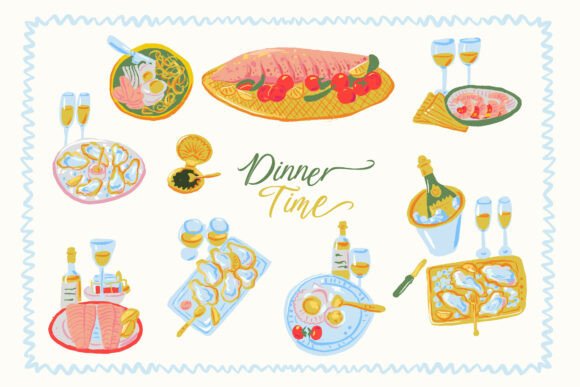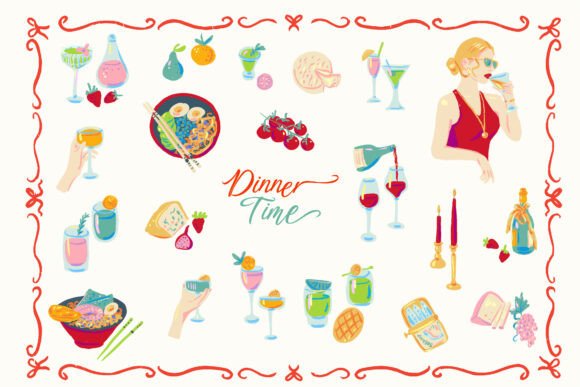
Dinner Time Delights Food Collection
First Impressions: Whimsy That Stitches Well
Opening Dinner Time Delights Food Collection feels like flipping through a well-loved sketchbook—warm, intentional, and full of quiet personality. These aren’t clipart-style icons; they’re handdrawn illustrations with gentle line weight variation, subtle asymmetry, and just enough detail to read clearly at 3–4 inches tall. Think crooked coffee mugs, slightly lopsided donuts, herbs with uneven leaf clusters—not sterile perfection, but approachable charm. That’s exactly what makes this collection promising for embroidery: it leans into handmade authenticity instead of fighting it.
A Real Project Test: Embroidering a Linen Kitchen Towel Set
Last week, I prepped a small batch of linen tea towels for a local café’s holiday pop-up—simple cotton-linen blend, medium weave, no stretch. I chose the “Pasta & Herb” motif from Dinner Time Delights Food Collection for its balanced negative space and clear silhouette. What stood out immediately was how naturally the illustration translated to stitch: rounded shapes held clean satin-stitched edges, open areas left room for fill-stitch breathing room, and the handdrawn texture meant minor thread tension inconsistencies didn’t break the illusion. Customers loved the warmth—it felt personal, not mass-produced. That’s the quiet power of this collection: it supports the story your handmade product tells.
Where It Shines (and Where to Pause)
Dinner Time Delights Food Collection excels in projects where character matters more than clinical precision:
- Embroidered tote bags — The generous outlines and moderate detail hold up beautifully on canvas or duck cloth, especially when paired with contrasting thread.
- Sweatshirt and apron front panels — Larger motifs scale well without losing their sketch-like friendliness.
- Baby embroidery — Soft fruits, mugs, and baked goods read as gentle and nurturing—not too busy, not too minimal.
- Personalized gifts — A monogrammed napkin set with a tiny olive branch or lemon slice? Instant heirloom energy.
- Printable mockups and digital previews — As SVG graphics, these illustrate cleanly across platforms, helping Etsy sellers and small shop owners show realistic context before stitching.
But let’s be practical: not every surface is forgiving. On thin fabric like lightweight cotton voile, dense fill-stitch areas may pucker without proper cutaway stabilizer. On curved surfaces like caps, smaller motifs (like the mini espresso cup) need careful placement—tight curves distort fine lines. And while the handdrawn style hides minor alignment hiccups, tiny lettering or delicate stems—like those on the herb sprigs—can blur if stitched below 2.5 inches without adjusted density. Always test on scrap first, especially for commercial embroidery runs where consistency matters.
What This Collection Adds to Your Finished Product
It’s rare to find food-themed design assets that feel both joyful and grounded—and that’s the real value of Dinner Time Delights Food Collection. It lifts the perceived value of a simple embroidered pillow cover or kitchen towel because it reads as curated, not generic. Customers notice the difference: that slight wobble in the croissant curve says “made with care,” not “pulled from a template library.” For craft businesses and Etsy sellers, that translates directly to stronger brand consistency and higher buyer engagement—people want to support makers who choose thoughtful design assets, not default clipart.
It also builds trust. When you use an illustration that’s clearly designed *for* translation—not just adapted after the fact—the final product looks intentional. No awkward gaps in satin-stitch borders, no overfilled zones that bleed into adjacent elements. That professionalism shows up in photos, in mockups, and in person. Even in black-and-white mockups, the contrast and shape language hold up—meaning your listings look sharp whether customers browse on phone screens or print catalogs.
Practical Notes Every Embroidery Designer Should Keep Handy
Before committing to a full run—or listing a finished product using Dinner Time Delights Food Collection—here’s what I check every time:
- Test on scrap fabric matching your final substrate—linen behaves differently than terry cloth, and cotton-poly blends react uniquely to stabilizer.
- Review stitch density in your embroidery software. If fill areas feel heavy, reduce density by 5–10%—especially for baby items or towels meant for frequent washing.
- Confirm hoop size compatibility. Most motifs fit comfortably in a 4×4 hoop, but layered compositions (like the “Breakfast Board” scene) may need 5×7. Don’t assume.
- Inspect small details at actual stitch-out size. That cute little steam curl above the teacup? It’s charming—but only if it doesn’t vanish into a single running stitch.
- Check thread color contrast against both light and dark backgrounds. Handdrawn lines rely on clarity—low-contrast combos (e.g., light gray thread on oatmeal linen) can mute the illustration’s expressiveness.
- Use proper stabilizer—especially for textured fabrics like terry or looped cotton. A tear-away alone won’t prevent shadowing on dense fills.
- Verify licensing before selling finished items or digital products. Since this is marketed as Illustrations for creative use across print and digit, confirm whether commercial embroidery rights are included—or if attribution or limitations apply.
Final Thought: A Collection That Feels Like a Collaborator
Dinner Time Delights Food Collection doesn’t shout. It invites. It works with your process—not against it. Whether you’re stitching a one-off personalized gift or producing a line of boutique kitchen textiles, it gives your work visual warmth without demanding technical gymnastics. That’s the mark of well-considered Graphics: they serve the maker first, the machine second, and the customer last—but in the best possible way. If your next embroidery project needs soul, not just silhouette, this collection earns its place in your working library.