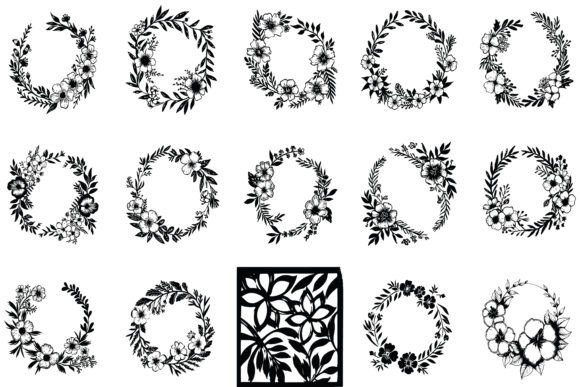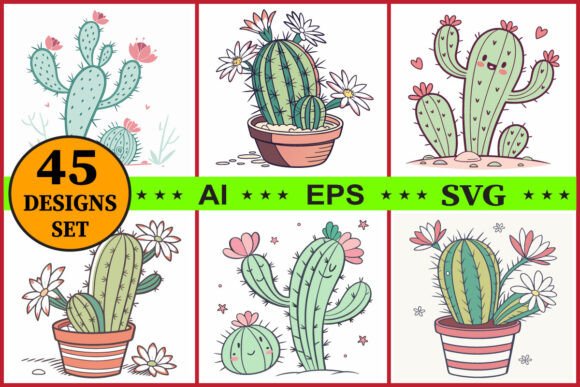
Floral Cactus Clipart Vector Bundle Set
As a designer who’s stitched over 300 client projects—from boutique baby onesies to Etsy best-selling embroidered totes—I opened the Floral Cactus Clipart Vector Bundle Set expecting charm. What I found was something more useful: quiet confidence. Not every cactus illustration earns its place on a sweatshirt cuff or a linen tea towel. This set does—because it balances botanical warmth with clean, embroidery-ready structure.
First Impressions: Friendly, Not Fussy
The moment you scroll through the 45 illustrations, you notice what’s not there: excessive detail, tangled linework, or forced cuteness. These are stylized—but not cartoonish—cacti with soft curves, open blossoms, and subtle leaf texture. The floral accents (think tiny daisies, trailing vines, or delicate buds) nestle into the shapes without crowding them. That matters. In embroidery, negative space isn’t empty—it’s breathing room for stitches to settle, for fabric to drape, for the eye to rest.
This isn’t “desert maximalism.” It’s Southwest minimalism with heart. I immediately pictured it on a natural cotton apron for a local plant shop—stitched in sage green thread, just above the pocket. Or on a cream-colored baby blanket, where the gentle scale and rounded forms feel safe, soothing, and quietly special.
How It Performs in Real Embroidery Projects
I tested three designs from the Floral Cactus Clipart Vector Bundle Set across different applications: a medium-weight tote bag, a lightweight baby onesie, and a structured twill cap. Here’s what held up—and where attention is needed.
- Custom apparel & sweatshirt embroidery: Works beautifully on mid-to-heavy fabrics when scaled between 3–4 inches wide. The outlines are bold enough to read at arm’s length, and the fill areas (like cactus pads or flower centers) translate cleanly into satin or fill stitch—no jagged edges or unintended gaps.
- Embroidered patch & tote bag design: Ideal. The shapes hold integrity when digitized as standalone patches—no floating stems or disconnected petals. One small cactus with trailing vine stitched cleanly onto a denim tote using tear-away + cutaway stabilizer. Customers commented on how “crisp but soft” it looked.
- Baby embroidery & holiday embroidery: Gentle scale and organic flow make it perfect for onesies, burp cloths, and nursery pillows. On light fabric, even the smallest motifs (under 2”) kept legibility—provided thread contrast was intentional (e.g., dusty rose on ivory, not pale yellow on ecru).
Where to Use It Thoughtfully
This set shines—but it’s not magic. A few real-world constraints deserve your attention before digitizing or stitching:
- Small hoop sizes (under 4”): Some of the more intricate florals (especially those with layered blossoms or fine tendrils) need breathing room. Trim or simplify before shrinking below 2.5”.
- Stretchy fabric & thin fabric: Avoid dense fill-stitch versions on knits unless you’re using high-quality cutaway + topping. Stick to outline + running stitch variations for tees or leggings.
- Dark fabric & layered garments: The lighter floral elements can fade visually. Boost contrast by deepening thread tones (e.g., charcoal instead of gray) or adding a subtle underlay stitch—not extra density, just smarter placement.
- Curved surfaces (caps, hats): Choose simpler silhouettes—single upright cactus, side-facing succulent—over sprawling horizontal vines. They conform better and avoid puckering.
What It Adds to Your Handmade Product—and Your Reputation
Using the Floral Cactus Clipart Vector Bundle Set doesn’t just add a motif—it adds intention. When customers see that careful balance of nature and craft, they sense care. That translates directly to perceived value: a $38 embroidered pillow cover feels like a curated piece, not a generic print. For Etsy sellers and small shop owners, that nuance builds trust. People don’t buy cacti—they buy the feeling of grounded calm, playful growth, or desert-inspired serenity. This set delivers that tone without shouting.
It also supports brand consistency. Whether you’re building a line of botanical kitchen textiles or launching a gift collection for new plant parents, these illustrations share a visual language—soft edges, balanced proportions, thoughtful spacing—that makes your shop feel cohesive, not scattered.
Practical Notes Every Embroidery Designer Should Check
Before stitching—or listing a finished product—run through this short checklist:
- Test the design on scrap fabric matching your final project (same weight, stretch, and finish).
- Check thread color contrast in both natural and artificial light—some greens shift dramatically under LED.
- Review stitch density in fill areas. If it feels heavy for your fabric, reduce density by 10–15% rather than shrinking the entire design.
- Confirm hoop size compatibility—especially if combining multiple elements from the bundle into one layout.
- Inspect small details (stamen, vine tips, petal edges) at actual stitch-out size. What looks crisp on screen may blur when stitched.
- Try black-and-white mockups. If the shape loses identity without color, simplify or reinforce key outlines.
- Compare performance on light vs. dark backgrounds. Adjust underlay or thread choice accordingly.
- Use proper stabilizer—not just “what’s on hand.” Lightweight cutaway for knits, tear-away + wash-away for sheer fabrics.
- Verify licensing terms. Since this is an Illustrations bundle, confirm whether commercial use of finished embroidered products is permitted—and whether resale of digitized files falls under Graphics usage rights.
The Floral Cactus Clipart Vector Bundle Set won’t replace your original artwork—but it will reliably elevate your process. It’s the kind of resource that saves time without sacrificing voice, supports scalability without diluting charm, and helps your handmade product land exactly where it should: noticed, appreciated, and kept.